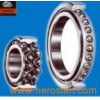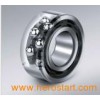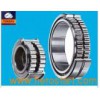


A thrust bearing is a particular type of rotary bearing. Like other bearings they permit rotation between parts, but they are designed to support a high axial load while doing this. Thrust ball bearings consist of two precision chrome steel washers (ring) and a ball complement spaced by bronze retainer. They can be supplied with or without radius ball grooves in the rings. Thrust bearings are used under purely axial loads. They are commonly used in automotive, marine, and aerospace applications. Thrust bearings are used in cars because the forward gears in modern car gearboxes use helical gears which, while aiding in smoothness and noise reduction, cause axial forces that need to be dealt with. The double helical or herringbone gear balances the thrust caused by normal helical gears. One specific thrust bearing in an automobile is the clutch "throw out" bearing, sometimes called the clutch release bearing. Fluid-film thrust bearings were invented by Australian engineer George Michell (pronounced Mitchell) who patented his invention in 1905. Michell bearings contain a number of sector-shaped pads, arranged in a circle around the shaft, and which are free to pivot. These create wedge-shaped regions of oil inside the bearing between the pads and a rotating disk, which support the applied thrust and eliminate metal-on-metal contact.